An Executive MBA (EMBA) is designed for experienced professionals looking to advance into leadership roles. Here's what you need to know.
The Executive MBA (EMBA) is specifically designed for the people in the corporate world be it, executives or managers. If you are a corporate who wants to future proof your skills over your peers an MBA will help you gain a ton of valuable experience which results in advancement in one's career. The degree can help evolve their awareness and knowledge on leadership, strategy, management, innovation and much more. Want to know more about what is an executive MBA is?? Read along
How a Weekend MBA Program Could Help You Earn Your MBA Degree
In most cases, an EMBA is a 1 to 2-year program which is designed for the benefit of working professionals.
Since it is planned for working professionals the duration of the class is minimum such that it would not affect their job duties and profession.
The classes usually happen in the evening or weekends keeping the working professionals and their schedules in mind. On average the class should be attended for 6-10 hours.
An Executive MBA program usually places a great deal of emphasis on teamwork, you'll usually be expected to work closely with the same students for the duration of the program.
Why Business Students prefer to get an Executive MBA Program
Unlike any other course or program, an Executive MBA puts more emphasis on practical application. Learning business knowledge and theory is just one part of the coin. During the MBA you will also be continuously applying it, which would strengthen your soft skills and expand your knowledge and decision making skills to lead.
Candidates of EMBA
Usually done by people who are in the midstage of their profession who wants to take up a new role, increase their career option, or those who want to increase their skill sets and brush up their knowledge.
Candidates who are applying for this usually have more than 10-15 years of industry experience in their domain. The entire set of the crowd coming to get their EMBA would be from diverse backgrounds and industries which leads to more exposure of people with different skillsets and perspectives. It is a program that emphasis more on networking so that they can learn from the experience of each other.
Difference between MBA and EMBA
|
BASIS FOR COMPARISON |
MBA |
EXECUTIVE MBA |
|
Meaning |
MBA is a master degree course usually pursued to develop a complete understanding of business and management. |
EMBA is a post-graduate program for the working professionals, i.e. executives, managers, leaders and other professionals. |
|
Approach |
Theoretical and Practical |
Practical |
|
Course |
Full-Time |
Part-Time |
|
Duration |
Long |
Comparatively short |
|
Classes |
Regular classes throughout the academic year. |
Evenings and Weekends only |
|
Fees |
High |
Comparatively Low |
|
Eligibility for admission |
Graduation plus the minimum required cutoff marks. |
Graduation plus minimum work experience. |
|
Appropriate for |
Students who want to pursue a master's degree in business management, in order to get a managerial level job. |
Experienced individuals who want to enhance their skills and get a boost in their career. |
Choosing an EMBA
Choosing an EMBA program is a crucial decision and may not be taken lightly.
You need to search out a program that's accredited and offers smart academic opportunities.
Finding an EMBA program that's comparatively close by may also be necessary if you plan to still work whereas earning your degree.
There are some colleges that provide online opportunities. This might prove to be a decent possibility if they're properly accredited and meet your academic needs and career goals.
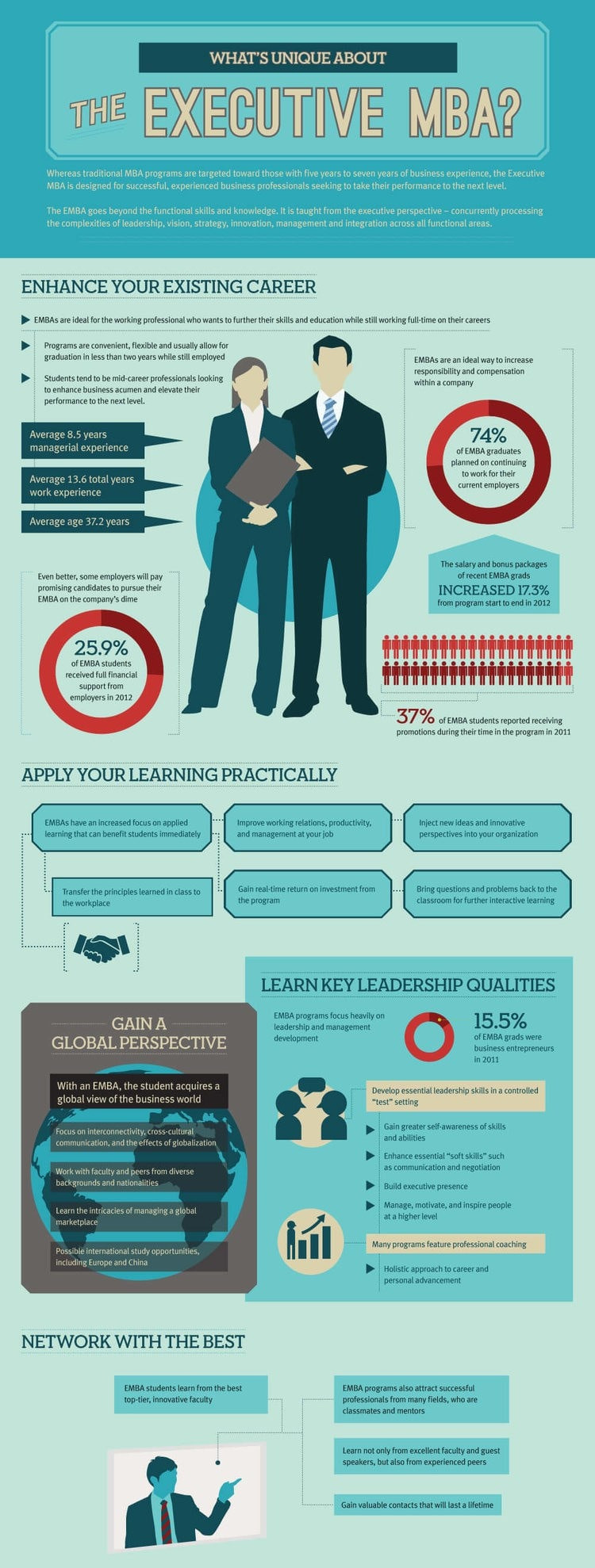
Source:- https://onlinemba.wsu.edu/resources/all/infographics/whats-unique-about-the-executive-mba
Executive MBA Program Costs
Education obviously comes at a prize, and the cost of an EMBA is extraordinary. MBA program is just shy of $75,000 every year. In the event that the normal program which takes 2 years to finish, you would end up shelling upto $150,000.
When you want to pursue an EMBA usually Employers often encourage the employees to do so. Hence the interested candidate doesn’t have to pay the entire amount of the bill on his own. So it is always advisable to converse with your employer before cancelling your EMBA dreams seeing the price tag. There are also many financial aid options available such as grants and scholarships. All these will add up in lowering your tuition fee, and then you can calculate your potential rate of return on investment.
Executive MBA Pros
- An average EMBA can increase your salary by at least 20% and more if done from top tier colleges.
- Increasing professional responsibility and leadership skills
- A valuable network of high-level academic peers and contacts from different industries.
- Drastically increases chances of a promotion within the current workplace.
Executive MBA Cons
- An average tuition of almost $78,000
- 16-22 hours per week to complete class and assignments managing time with work becomes critical
- With many candidates managing high workload and stress scheduling classes around existing job duties becomes quite a task
- Not all employers will sponsor tuition fees
Colleges offering Executive MBA
Conclusion
It is a program that would provide you great flexibility, as you can learn while working, thus it will impact you with skills due to which you can accept more responsibility or even pursue promotion opportunities. Thus Executive MBA is perfect for working professionals.
Blogs you maybe interested in
- American Council for Construction Education (ACCE)
- What is American Occupational Therapy Association Accreditation Council for Occupational Therapy Education (AOTA)
- Accrediting Council on Education in Journalism and Mass Communications (ACEJMC)
Free Weekly Newsletter
Never Miss a Deadline Again
Scholarship alerts, application tips, and FAFSA reminders delivered every Tuesday. Free, useful, no fluff.
Subscribe Free →No spam. Unsubscribe anytime.
★ Key Takeaways
Source: The College Monk — Based on data from 3,837 U.S. universities. Last updated September 2026.
Want to boost your college admissions odds?
Explore our free tools: College Comparison and Admissions Calculator — built on data from 3,800+ universities.
Compare Colleges →Admissions Calculator →📋 The College Planning Kit — $29.99
Application checklists, financial aid worksheets, comparison templates, and deadline trackers. Everything you need in one kit.